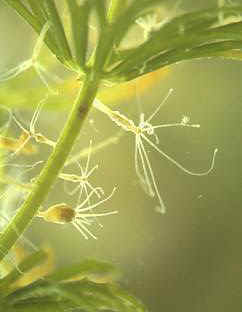
Hydra - Immortal Metazoan life form, Example of Immortality |
( Log In | Register ) · My Assistant
![]() ![]() |
Hydra - Immortal Metazoan life form, Example of Immortality |
Feb 21 2003, 07:57 PM
Post
#1
|
|
Group: Lifetime Member Threadstarter Joined: 7-August 02 Posts: 8,694 From: San Francisco, CA |
Hydra: Immortal
Quote: Senescence, a deteriorative process that increases the probability of death of an organism with increasing chronological age, has been found in all metazoans where careful studies have been carried out. There has been much controversy, however, about the potential immortality of hydra, a solitary freshwater member of the phylum Cnidaria, one of the earliest diverging metazoan groups. Researchers have suggested that hydra is capable of escaping aging by constantly renewing the tissues of its body. But no data have been published to support this assertion. To test for the presence or absence of aging in hydra, mortality and reproductive rates for three hydra cohorts have been analyzed for a period of four years. The results provide no evidence for aging in hydra: mortality rates have remained extremely low and there are no apparent signs of decline in reproductive rates. Hydra may have indeed escaped senescence and may be potentially immortal. ![]() Quote: My dissertation work included a study of aging in Hydra addressing the controversy regarding the immortality of this creature. I have continued this work at UC Irvine. Individual hydra have been kept alive for almost four years now. Only a few animals have died during this period and there has been no apparent decline in budding rates. This suggests that hydra seems to escape aging, a process known to affect all other metazoans. This work has lead to an interest in investigating the presence of telomerase in hydra. Telomeres are nucleoprotein complexes at the end of chromosomes which protect chromosomes from degradation and fusion. Unless they are maintained, telomeres shorten with multiple cell divisions. Shortening of chromosomes might be responsible for "replicative aging", i.e., the finite proliferative capacity of somatic cells. Germline cells of most eukaryotes maintain their chromosomal ends by the action of telomerase, a ribonucleoprotein enzyme. Somatic cells appear to lack mechanisms to prevent the shortening of telomeres; perhaps an evolved trait to limit the proliferative potential of somatic cells in multicellular organisms. The epithelial cells of hydra, however, have retained their proliferative capacity. This results in the constant renewal of hydra's body and might explain hydra's immortality. The mechanism for preserving telomere integrity in the somatic cells of hydra is not known. I plan to investigate the presence of telomerases in the somatic cells of hydra in the future. This work could include cnidarians that undergo aging, e.g. several colonial hydroids, to investigate whether or not the evolution of aging is related to the loss of telomerase activity in somatic cells. http://www.biology.pomona.edu/martinez/aging.html
|
|
|
|
Feb 25 2003, 08:06 PM
Post
#2
|
|
Group: Lifetime Member Threadstarter Joined: 7-August 02 Posts: 8,694 From: San Francisco, CA |
This is a question for those who may have some insight --
Hydra escape aging by constantly renewing the tissues of its body... but how do they overcome the problem in nature of bacteria and viruses 'catching up' to them and taking them out? |
|
|
|
Apr 1 2003, 09:39 AM
Post
#3
|
|
Group: Lifetime Member Threadstarter Joined: 7-August 02 Posts: 8,694 From: San Francisco, CA |
In answer to my question about the problem of viruses... i think this answers it.. DNA accumulates imperfections which allow for change with each division... the following is from WSU's 'Ask Dr. Universe' ::
As single cell creatures, are amoebas immortal? I wouldn't exactly call that immortality, but I understand what you mean. Most amoebas reproduce by increasing the amount of their cytoplasm, copying their DNA, and dividing in half. So the two resulting amoebas are genetically identical! Of course, amoebas can die - they can get eaten or come into contact with toxic chemicals or something - but if a clone has been made... Yes, if a single amoeba divides in two, then those two divide again, how would you know which one was the "original"? They are all the original! (Although the cytoplasm is not always divided up evenly between the two.) In that sense, you might be able to say that an amoeba can survive for a very long time, by dividing into clones. But that's not the same as immortal. See, over time, DNA accumulates mutations (yours and mine too), so changes happen even though the amoebic DNA is supposed to be copied exactly. Mutations can be caused by chemicals, UV light, or just by errors in DNA replication. In plants and animals, these mutations can sometimes introduce new variations into the population. And amoebas are affected by mutations too. They are only single-celled, and when they reproduce by doubling their DNA and dividing in half, those mutations get passed along, and on and on, so that over time, there are changes in how the amoeba looks and how it lives. After several generations, it is really not the same amoeba anymore! Animals like us that reproduce by sexual reproduction - male and female combining chromosomes - have much more variety in our populations because of it. Mutation helps, but it's not the only thing. Amoebas rely on mutation to bring variety. http://druniverse.wsu.edu/QandA.asp?questionID=5482 |
|
|
|
Apr 1 2003, 06:22 PM
Post
#4
|
|
|
Group: Registered User Joined: 22-August 02 Posts: 1,096 |
Viral pressures and mutation would of selected for these:
*aggressive lysozymes (destroys bacterial walls) *aggressive immune system Now that I looked into it more I side with the above. This post has been edited by XxDoubleHelixX: Apr 2 2003, 05:00 AM |
|
|
|
May 26 2007, 05:54 AM
Post
#5
|
|
|
Group: Member Joined: 8-June 06 Posts: 1,973 From: Perth Australia |
Do you guys have any more info / papers on hydras mitochondrial genome?
I found this on google: http://warriorlab.bio.uci.edu/publications...PontKingdon.pdf Just a germ of an idea now but what would Hydras closest non-immortal relative be? |
|
|
|
| Googlebot |
Post
#
|
|
Go ad free, join ImmInst as a Full Member. |
|
|
|
![]() ![]() |
| Topic | |||||
|---|---|---|---|---|---|
![]() |
Life extension conference organizing fundraising on a global scale |
7 | s123 | 210 | Today, 12:04 AM brokenportal |
![]() |
Immortality Techniques?!?! Please share what you've done that WORKS!!! |
8 | immortality | 341 | 5th February 2010 - 11:31 PM Teixeira |
![]() |
Lifestyle to increase intelligence ? | 33 | Solarclimax | 2,131 | 1st February 2010 - 11:42 AM David Styles |
![]() |
Forming a dedicated group for voting and support | 12 | Cyberbrain | 558 | 29th January 2010 - 08:26 PM Shepard |
![]() |
lifestyle changes how do you take your first step |
2 | medicineman | 160 | 17th January 2010 - 07:50 AM lunarsolarpower |