Astragalus, Astragaloside IV, and telomerase |
( Log In | Register ) · My Assistant
![]() ![]() |
Astragalus, Astragaloside IV, and telomerase |
Jan 16 2008, 05:17 AM
Post
#1
|
|
Group: Member Threadstarter Joined: 12-March 07 Posts: 1,383 From: Southeast USA |
Anyone know of any economical sources for telomerase activators? (not TA-65 which is not economical nor available that I know of without entering into their protocol paid lab rat situation) To me these have the potential to put Resveratrol to shame with regards to extending lifespan.
Currently I take Astragalus standardized to 4% isoflavones at about a gram a day (though I have no idea how much astragalosides are in this I take it because it is cost effective) Also I take 500 mg of another product Natures Way standardized to 0.5% astragalosides. Alternatively you could get Gaia's product also standardized to 0.5% astragalosides. But both of these have so little astragalosides in them that in order to get 40-50 mg which I read somewhere was effective one would have to take a lot. There are also products standardized to 70% polysaccharides, which from what I have read would include some astragalosides. The whole issue is kind of muddy to me, any clarity would be appreciated. |
|
|
|
Jan 16 2008, 06:04 PM
Post
#2
|
|
|
Group: Registered User Joined: 25-July 06 Posts: 1,396 From: California |
I'm interested as well, but I don't have any answers.
|
|
|
|
Jan 16 2008, 10:46 PM
Post
#3
|
|
Group: Member Joined: 15-February 07 Posts: 1,077 From: Atlanta, Ga |
The particular astragalus species that TA-sciences works with is: Astragalus propinquus (Maybe)(The paper referred to later talks about extraction of astragalosides I-VII from: Astragalus membranaceus via methenol refluxion)
The major active constituent in astragalus is astragaloside IV. Reading from Geron's: Compositions and Methods for Increasing Telomerase Activity (someone had to read and make sense of the thing) http://www.wipo.int/pctdb/en/wo.jsp?WO=200...;DISPLAY=CLAIMS They patent the use of 3 formulas: Embodiments of formula 1: QUOTE Exemplary compounds of formula I include astragaloside IV, cycloastragenol, astragenol, astragaloside IV 16-one, cycloastragenoI6-I3-Dglucopyranoside, and cycloastragenoI3-I3-D-xylopyranoside. In selected embodiments, the compound is selected from astragaloside IV, cycloastragenol, astragenol, and astragaloside IV 16-one. In one embodiment, the compound is astragaloside IV. Embodiments of formula 2 seems to be lots of variations of of the chemical formula in formula one where there can be alkoxy, hydroxy, glucoside and keto groups substituted at various positions. This seems to be a patent of future small molecule forumlations and is not likely part of TA-65 from what I can tell. Principle Exemplary Compounds specifically enumerated: QUOTE 1 (astragaloside IV) 2 (cycloastragenol), 3 (astragenol) 4 (astragaloside IV 16-one) 5 (20R,24S-epoxy-3B, 16B,25-trihydroxy-9B-methyl-19norlanost-l,5-diene) 6 (cyc1oastragenoI6-13-D-glucopyranoside) 7 (cycloastragenol 3-13D-xylopyranoside) 8 (ginsenoside RH1). Any of these should produce significant telomerase activity. The in-vitro studies seem to have been done with DMSO + Compound mentioned above. On formulation and (in vitro?) concentrations to have telomerase lengthening efficacy: QUOTE A preferred compound offormula I, II or ill above, when formulated in a solvent at a concentration of 1 ug/ml or less, is effective to produce a level of telomerase activity in keratinocytes or fibroblasts, as measured in a TRAP assay, at least 50% greater than the level in said cells treated with said solvent, as measured in a TRAP assay as described herein. In further preferred embodiments, the compound is effective to produce a level of telomerase activity in keratinocytes or fibroblasts, as measured in a TRAP assay, at least 100% greater than the level in said cells treated with said solvent, as measured in a TRAP assay as described herein. On topical formulation: QUOTE The topical formulation typically comprises one or more components selected from the group consisting of an emulsifier, a thickener, and a skin emollient. Such compositions may be used for treatment of wounds or other acute or chronic conditions of the epidermis. I could delve into the extraction process that they describe involving Astragalus membranaceus which produces many products which fit into the formula I-III descriptions. Once initial extraction is done further chemical modifications can be done to slightly alter the chemical structure of any given substance. Conclusion: Despite how unprofessional and all around sketchy Ta-Sciences is, Geron did their homework and it shows. I have only read about 25% of their 75 page paper but it is damn impressive work. And the note for the masses: astragaloside IV should do the job just fine (this doesn't mean I personally endorse taking astragalus, in fact I don't take it myself). I'll have to read more later about what vehicle they recommend for oral administration. This post has been edited by lucid: Jan 17 2008, 04:17 AM |
|
|
|
Jan 17 2008, 03:25 AM
Post
#4
|
|
|
Group: Navigator Joined: 15-December 06 Posts: 5,987 From: Philadelphia |
Thanks for sorting that out, lucid. Patents are horrid to read. This one has some weird typos involving interchange of the characters i,I,l, and 1. That suggests either some bad OCR or an old-school typist who wasn't hip to ASCII. I'm guessing "I-lg/ml" is really supposed to be mg/ml, or might it be microgram?
|
|
|
|
Jan 17 2008, 04:02 AM
Post
#5
|
|
Group: Member Joined: 15-February 07 Posts: 1,077 From: Atlanta, Ga |
Thanks for sorting that out, lucid. Patents are horrid to read. This one has some weird typos involving interchange of the characters i,I,l, and 1. That suggests either some bad OCR or an old-school typist who wasn't hip to ASCII. I'm guessing "I-lg/ml" is really supposed to be mg/ml, or might it be microgram? Sorry about those types they are probably my fault / adobes fault. You can't copy and paste from the pdf which I was reading. In order to copy and paste I had to have acrobat view the pdf as an image and then convert that to text which I could then paste. So the mess ups you observed were characters that adobe had difficult distinguishing between. I'll fix those in my post though. This post has been edited by lucid: Jan 17 2008, 04:07 AM |
|
|
|
Jan 18 2008, 07:53 PM
Post
#6
|
|
Group: Member Threadstarter Joined: 12-March 07 Posts: 1,383 From: Southeast USA |
Checking out sources for Astragaloside IV
|
|
|
|
Jan 19 2008, 04:08 AM
Post
#7
|
|
Group: Member Joined: 15-February 07 Posts: 1,077 From: Atlanta, Ga |
Damn, pure Astragaloside IV is quite expensive, no wonder TA-Sciences wanted so much money.
@ a dosage of 50mg a day. (I'm not completely sure that this is the right dosage) A year supply is: 18g 50g of 95% Astragaloside is $1580 @ http://www.biopurify.com/ 50g of 99% Astragaloside is $2080 So a year supply @ 50mg/day is $568 using the 95% mixture. Still 600$ a year beats the pants of the 20k Ta-Sciences wants. If there were some studies showing this stuff increases lifespan in mice then I might try it. Not going to screw with this stuff until then though. Telomerase is a fickle enzyme. It is cancer preventative, but 95% of cancer cells express lots of it. Hence, Telomerase levels might be pretty important (You may not want too much or too little). At anyrate, as tempting as it may be, I'm not ready to guinea pig myself. This post has been edited by lucid: Jan 19 2008, 04:09 AM |
|
|
|
Jan 19 2008, 05:42 AM
Post
#8
|
|
Group: Member Threadstarter Joined: 12-March 07 Posts: 1,383 From: Southeast USA |
I just got my quote too.
1) Astragaloside IV >95% By HPLC-ELSD 100g USD2980.00. 1kg USD 23840.00 2) Astragaloside IV >98% By HPLC-ELSD 100g USD3980.00. 1kg USD 31840.00 www.biopurify.com also (they are a Chinese company so no middle men, so probably about as cheap as you can get) Apparently its a little cheaper with more volume ($1490/50g if you buy 100 grams and $1192/50 grams if you buy a kg) It actually works out to about the same $ amount per day as taking 2-5 grams a day of T-Res. Yes I agree with Lucid we need some Rat studies. If some do come out then we could maybe consider a group buy. I am sure that the prices are due to the lack of demand and the limited number of suppliers, just like Resveratrol in the beginning. Once studies come out and more suppliers enter the market the price will drop dramatically especially since there is already a market for Astragalus as an immune system booster so there is a lot of cheap raw material around that just needs to be purified and standardized. Now if I wasn't working and going to school right now (had more cash floating around) I might consider adding it to my regimen or if I could get smaller quantities for the same cost savings as larger amounts (ie its not worth it right now for me to organize a group buy... but if anyone else wants to do it i'll gladly buy a few months supply from them) This post has been edited by edward: Jan 19 2008, 05:46 AM |
|
|
|
Jan 22 2008, 08:52 PM
Post
#9
|
|
|
Group: Registered User Joined: 25-August 07 Posts: 79 |
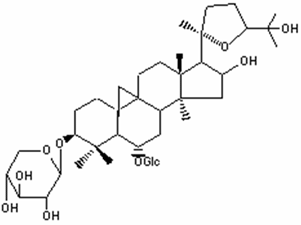
And the note for the masses: astragaloside IV should do the job just fine Based on the patent, I don't think it's possible to know which astragaloside is the one Geron is licensing as TA-65. If you have some reason to believe it is astragaloside IV, it would be helpful to know this. Currently, the only products I've found which have a stated level of astragalosides are one with 0.3% and Nature's Way Astragalus Extract, which is Standardized to 0.5%. These capsules contain 250mg of extract, so it's only 1.25mg of astragalosides per capsule. The TA Sciences protocol uses 5mg/day of TA-65. If TA-65 is astragaloside IV, it would be helpful to know what % of astragaloside IV is among the total astragalosides in astragalus, but I was not able to track down this information yet. This was one of the most helpful analyses and discussions of astragalus that I found online: http://www.itmonline.org/arts/astragalus.htm. Here is part of their discussion on astragalosides: QUOTE The saponins of astragalus include several called astragalosides (-oside indicates that it is a glycoside, that is, has a sugar attached to an active molecule, such as a pentacyclic compound usually found in saponins). In a study of astragalus roots from China, the saponin content was found to be from 0.019 to 0.184%, with astragaloside I as the main component (10); others consider that astragaloside IV is the main component (see image, below). When astragalus extracts are made and standardized for saponin content, a 0.5% saponin level is the most that is usually attained (one Chinese source indicates a range of 0.2 to 20% saponin content available). In a previous analysis of saponin-containing herbs, it was shown that to get substantial activity for these compounds one would need to administer doses of 60-900 mg (11). Based on a maximum root content of about 0.184% saponins, a 15 gram daily dose of astragalus might yield about 28 mg total saponins, a small amount. These saponins of astragalus, if they were given in sufficient quantity, may have properties of reducing inflammation, resolving phlegm, reducing platelet sticking, and promoting cardiac function. ![]() It seems to me that a reasonable dose of 0.5% astragalus extract might be about 9 capsules a day, providing 11.25mg of astragalosides. |
|
|
|
Jan 22 2008, 09:16 PM
Post
#10
|
|
Group: Member Joined: 15-February 07 Posts: 1,077 From: Atlanta, Ga |
QUOTE Based on the patent, I don't think it's possible to know which astragaloside is the one Geron is licensing as TA-65. If you have some reason to believe it is astragaloside IV, it would be helpful to know this. What Geron found was that lots of different varieties of astragalosides (not all of them are naturally occuring) activate telomerase production. They each activate telomerase to different degrees. Here is a table of the concentration needed of the various substances to activate telomerase 2x compared to the dmso control:
table1.bmp ( 713.68K )
Number of downloads: 814Hence any of these should do the job OK. Astragaloside IV is one of the better ones. As far as the pricing goes. The links edward and I posted earlier were for 95% pure extractions, hence they were pretty expensive. This stuff is pretty strong and shouldn't be played with. We need some more animal studies. |
|
|
|
Jan 22 2008, 10:35 PM
Post
#11
|
|
|
Group: Registered User Joined: 25-August 07 Posts: 79 |
Ah, that's clearer. So it seems that getting mixed astragalosides might be fine. Perhaps 6 to 9 capsules of the Nature's Way should be adequate.
What Geron found was that lots of different varieties of astragalosides (not all of them are naturally occuring) activate telomerase production. They each activate telomerase to different degrees.
Here is a table of the concentration needed of the various substances to activate telomerase 2x compared to the dmso control:
table1.bmp ( 713.68K )
Number of downloads: 814Hence any of these should do the job OK. Astragaloside IV is one of the better ones. As far as the pricing goes. The links edward and I posted earlier were for 95% pure extractions, hence they were pretty expensive. This stuff is pretty strong and shouldn't be played with. We need some more animal studies. |
|
|
|
Jan 22 2008, 10:53 PM
Post
#12
|
|
Group: Navigator Joined: 23-December 06 Posts: 2,246 From: New York |
Ah, that's clearer. So it seems that getting mixed astragalosides might be fine. Perhaps 6 to 9 capsules of the Nature's Way should be adequate. What Geron found was that lots of different varieties of astragalosides (not all of them are naturally occuring) activate telomerase production. They each activate telomerase to different degrees. Here is a table of the concentration needed of the various substances to activate telomerase 2x compared to the dmso control:
table1.bmp ( 713.68K )
Number of downloads: 814Hence any of these should do the job OK. Astragaloside IV is one of the better ones. As far as the pricing goes. The links edward and I posted earlier were for 95% pure extractions, hence they were pretty expensive. This stuff is pretty strong and shouldn't be played with. We need some more animal studies. Cancer cells extend their telomeres. If you do this artificially throughout the body it could have unwanted results. Definitely need more studies. |
|
|
|
Jan 22 2008, 11:23 PM
Post
#13
|
|
Group: Member Joined: 15-February 07 Posts: 1,077 From: Atlanta, Ga |
QUOTE Telomerase is not an oncogene Calvin B Harley Geron Corporation, Menlo Park, California, CA 94025, USA Correspondence to: C B Harley, Geron Corporation, 230 Constitution Drive, Menlo Park, California, CA 94025, USA; E-mail: charley@geron.com Abstract In the decade since the telomere hypothesis of cellular aging was proposed, the two essential genes for human telomerase were cloned and characterized, allowing experimental proof of the causal relationships between telomere loss and replicative senescence, and telomerase activation and immortalization. These relationships were established using a variety of cultured human cell types from both normal and tumor tissues, and were largely confirmed in the telomerase knockout mouse. Taken together, the data provide strong support for the potential utility of telomerase detection and inhibition for cancer, and telomerase activation for degenerative diseases. The specificity of the promoter for the telomerase catalytic gene and the antigenicity of the protein product, hTERT, provide additional strategies for killing telomerase-positive tumor cells. Unfortunately, the strong link between telomerase and cancer has led some to confuse telomerase activation with cancer, and others to overstate the cancer risk of telomerase activation therapies for degenerative diseases. This review clarifies the difference between telomerase, which does not cause growth deregulation, and oncogenes, which do. It also addresses the concept of telomerase repression as a tumor suppressor mechanism early in life, with detrimental tissue degeneration and tumor-promoting consequences late in life. This extended view of the telomere hypothesis helps explain how telomerase inhibition can be therapeutic in cancer patients, while controlled telomerase activation for degenerative diseases may actually reduce, rather than increase, the frequency of age-related tumorigenesis. Full Paper : http://www.nature.com/onc/journal/v21/n4/full/1205076a.html Telomerase is a doubled edged sword, on one hand it induces apoptosis in cells that sustain genetic damage and in that respect act as a cancer preventative agent. On the other hand, 95% of cancers express telomerase. It is complicated. Some old threads on it: Telomerase Therapy: http://www.imminst.org/forum/index.php?sho...p;hl=telomerase Telomerase does not lead to cancer: http://www.imminst.org/forum/index.php?act...;t=12276&s= |
|
|
|
Jan 23 2008, 10:13 AM
Post
#14
|
|
|
Group: Registered User Joined: 25-August 07 Posts: 79 |
Hmm... in reviewing tasciences.com, I came across this test they had done which claims that commercial astragalus extracts contain very little TA-65:
http://www.tasciences.com/pdf/dalton_pharma_01.pdf (linked from their FAQ page: http://www.tasciences.com/faq.html) If TA-65 was astragaloside iv, it would have been found in some substantial quantity, so it must be another compound. The sensitivity of the test was 1ppm, so it should have been able to detect as little as 0.001mg per gm. What we really need is to find out what TA-65 is -- what if we take up a collection and pay for one person to do the Patton protocol, then get the capsules analyzed to determine the compound? We could then legally buy it for personal use. The cost is $11,500 (plus testing). I'll volunteer to be the guinea pig, and I'll kick in 25% of the cost. What do you all think? And who would do the analysis? |
|
|
|
Jan 23 2008, 10:44 AM
Post
#15
|
|
Group: Member Joined: 15-February 07 Posts: 1,077 From: Atlanta, Ga |
Hmm... in reviewing tasciences.com, I came across this test they had done which claims that commercial astragalus extracts contain very little TA-65: http://www.tasciences.com/pdf/dalton_pharma_01.pdf (linked from their FAQ page: http://www.tasciences.com/faq.html) If TA-65 was astragaloside iv, it would have been found in some substantial quantity, so it must be another compound. The sensitivity of the test was 1ppm, so it should have been able to detect as little as 0.001mg per gm. What we really need is to find out what TA-65 is -- what if we take up a collection and pay for one person to do the Patton protocol, then get the capsules analyzed to determine the compound? We could then legally buy it for personal use. The cost is $11,500 (plus testing). I'll volunteer to be the guinea pig, and I'll kick in 25% of the cost. What do you all think? And who would do the analysis? If Ta Sciences announces impressive results then I'll look into it. (I can't remember when their trial is going to be done with) Testing this drug on yourself without animal studies is a really bad idea. The Ta Sciences guy at the SENS conference 3 basically got laughed off the stage when he explained patients in their trial were paying to be guinea pigs for a substance that has not been tested on animals. It is ok to be excited about the prospects of the substance, but most of us can afford a little bit of patience and wait for some real results. As to what is actually in TA-65... Who knows. They could have easily picked one of the more obscure telomerase activators just so they could say: "commercial astragalus extracts contain very little TA-65". You need to remember that TA Sciences bought rights to one of Geron's formulations. Their master plan must be something as follows: 1. Give a natural substance a wierd name (TA-65) and refuse to give any information about it. 2. Make people pay to sign up to use this substance. 3. Release clinical info about your new guinea pigs and create excitement (because the naturally occuring substance may actually work) 4. Hope that people will then buy your 'wierd named product' instead of getting the much cheaper 'not weirdly named product' (astragalus extract) I hope that this is doomed to fail as a business model. I would feel much more comfortable donating some money to research and having some real science done. Speaking of which, I wonder what Geron has been up to... Perhaps they are putting together a NCE for animal trials or something. That would be nice. *Googling* It seems that all of their telomerase activation work is being done by: TA Thereputics and the last product that I have seen them working on is TAT0002. Hmmm. |
|
|
|
Jan 23 2008, 01:39 PM
Post
#16
|
|
|
Group: Registered User Joined: 25-August 07 Posts: 79 |
If Ta Sciences announces impressive results then I'll look into it. (I can't remember when their trial is going to be done with) Testing this drug on yourself without animal studies is a really bad idea. They do have some results on their site from that 2005 study. The number of people in study was small, and the significance of the results isn't great in many cases, but it shows a positive trend and no negative trend. |
|
|
|
Jan 23 2008, 02:57 PM
Post
#17
|
|
|
Group: Member Joined: 19-September 06 Posts: 119 From: Germany |
Smithx, what I really appreciate is that you are ready to do something, not only the grey theory and talking about wonderful things, which may come in future, but directly trying to do something. I was also very interested in TA-65 although only telomerase activation may not be the only key to keep the cells away from the aging process. What I do not understand, is that all are so focussed on TA-65, an ingredient which is assumed to elongate the telomeres, although not even 1 study about astragalus and this activity can be found on www.pubmed.gov .
Perhaps my sceptical opinion about TA-65 has something to do with my studies (med. molecular bio.) and that I always want to see some more scientific evidents, so I like more abstracts published on pubmed, some scientists risking their reputation by publishing such amazing facts and not only a mysterious patent. On the one side you have TA-65, everybody trying to guess what could it be, it is unbelievable expensive and no studies. On the other side, there is Epitalon, about nobody seems to be really interested, a peptide which was investigated in several studies, even on human somatic cells and shows the activation of telomerase and the prolangation of telomeres. (1) "Addition of Epithalon peptide in telomerase-negative human fetal fibroblast culture induced expression of the catalytical subunit, enzymatic activity of telomerase, and telomere elongation, which can be due to reactivation of telomerase gene in somatic cells and indicates the possibility of prolonging life span of a cell population and of the whole organism." So it does help the cell bypassing the Heyflick limit. (2) Read this: "Primary pulmonary fibroblasts derived from a 24-week fetus lost the proliferative potential at the 34th passage. The mean size of telomeres in these cells was appreciably lower than during early passages (passage 10). Addition of Epithalon to aging cells in culture induced elongation of telomeres to the size comparable to their length during early passages. Peptide-treated cells with elongated telomeres made 10 extra divisions (44 passages) in comparison with the control and continued dividing. Hence, Epithalon prolonged the vital cycle of normal human cells due to overcoming the Heyflick limit." There were also some studies done on mice, where it shows anti aging properties, elongating the mean and maximum life span. Furthermore Epitalon protects from some sorts of cancer. (3) Read the cited studies and other on your own and then try to find something similar with the astragalus, TA-65 and so on. The scientists (Khavinson, Anisimov) who have done this studies with Epitalon, are working a long time in the aging research. You suggest to to be the first test person and you are ready to invest 25% of this huge amount of money to get the TA-65? Why invest so much money in something even not proved to work. Why losing time with speculation about the molecular structure? Why not buying a real telomerase activator instead of a 20.000 USD (may-work) supplement? I would rather invest my money in something that really works, was tested in several studies and does not cost so much. Epitalon may be very expensive when buying it from several manufacturers but I have the possibility to get it much more cheaper in bulk, it is a simple tetrapeptide, the structure is known and it is not difficult to synthesize and cheap in bigger amounts, cheaper then the mysterious TA-65. I will focus on Epitalon, if somebody is also interested PM me. (1) Khavinson VKh, Bondarev IE, Butyugov AA. Epithalon peptide induces telomerase activity and telomere elongation in human somatic cells. Bull Exp Biol Med. 2003 Jun;135(6):590-2. (2) Khavinson VKh, Bondarev IE, Butyugov AA, Smirnova TD. Peptide promotes overcoming of the division limit in human somatic cell. Bull Exp Biol Med. 2004 May;137(5):503-6. (3) Anisimov VN, Popovich IG, Zabezhinskiĭ MA, Rozenfel'd SV, Khavinson VKh, Semenchenko AV, Iashin AI. [Effect of epitalon and melatonin on life span and spontaneous carcinogenesis in senescence accelerated mice (SAM)] Vopr Onkol. 2005;51(1):93-8. This post has been edited by aidanpryde: Jan 23 2008, 03:00 PM |
|
|
|
Jan 23 2008, 09:46 PM
Post
#18
|
|
Group: Registered User Joined: 21-December 06 Posts: 26 |
I agree with Aidenpryde and Lucid.
Lucid, here's one example of a telomerase activating hormone actually reducing the spreading of cancer. These mice in this study were C3H/He mice, designed to get tumors and although the experimental group still had tumors, none of them were spreading to surrounding tissue. QUOTE Effect of the synthetic pineal peptide epitalon on spontaneous carcinogenesis in female C3H/He mice. Kossoy G, Anisimov VN, Ben-Hur H, Kossoy N, Zusman I. Koret School of Veterinary Medicine, Faculty of Agricultural, Food and Environmental Quality Sciences, The Hebrew University of Jerusalem, Rehovot, Israel. The potential preventive effect of the synthetic pineal peptide Epitalon (Ala-Glu-Asp-Gly) on spontaneous tumorigenesis in mice was studied. One-year-old female C3H/He mice were kept for 6.5 months under standard conditions. Epitalon was injected at a dose of 0.1 microg, 5 times a week. Long-term exposure to Epitalon in small doses did not show any toxic effect. Treatment with Epitalon decreased the number of tumor-bearing mice with malignant tumors and prevented the development of metastases. Spontaneous tumors of the reproductive organs (mammary glands and ovaries) were predominant in both groups of mice (control and experimental). The mammary gland tumors were different variants of invasive ductal carcinomas. In the ovaries, granulosa-cell tumors were found. Tumors were in the minority in other organs and had benign characteristics. In control mice, metastases were found in 3 out of 9 tumor-bearing mice, all of them being from tumors of the reproductive organs. Treatment with Epitalon slowed down the development of metastases from spontaneous tumors, and no metastases were found in the experimental mice. These data highlight the antimetastatic effect of Epitalon as part of its oncostatic properties. PMID: 16634527 [PubMed - indexed for MEDLINE] In terms of present research, Epitalon seems to be more promising for its telomerase promoting activity, than astragalus. Not to say that some component of astragalus won't turn out to be a life extender, but epitalon is an extremely tiny single hormone and as such penetrates tissues very well. There are fewer unknowns it seems in using epitalon for telomerase activation. One thing in support of astragalus and its extracts is its status as being derived from an herb, and as such, is defensible for a supplement company to use as a dietary supplement in accordance with FDA regulations until a pharmaceutical company files for new drug status, which won't happen because pharmaceutical companies want exclusivity in the production of their chemical (patentability) and would prefer to stare at the chemical for many years, until they come up with a synthetic analogue they can patent and sell without competition for x years. |
|
|
|
Jan 23 2008, 10:19 PM
Post
#19
|
|
|
Group: Registered User Joined: 25-August 07 Posts: 79 |
Thanks for the complement aidanpryde.
My reservations about epitalon include the fact that all the positive studies include Khavinson - no other group has duplicated their work. Also, the results aren't unequivocally good. Their best study showed no mean lifespan increase, even though it made the longest-lived mice live longer. QUOTE Document Type: Journal Article Pub Status: published Author(s): Anisimov, Vladimir N.; Khavinson, Vladimir K.; Popovich, Irina G.; Zabezhinski, Mark A.; Alimova, Irina N.; Rosenfeld, Svetlana V.; Zavarzina, Natalia Y.; Semenchenko, Anna V.; Yashin, Anatoli I. Title: Effect of Epitalon on biomarkers of aging, life span and spontaneous tumor incidence in female Swiss-derived SHR mice In Journal: Biogerontology Volume: 4 Issue: 4 Year: 2003 Start Page: 193 End Page: 202 Abstract: From the age of 3 months until their natural deaths, female outbred Swiss-derived SHR mice were subcutaneously injected on 5 consecutive days every month with 0.1 ml of normal saline (control) or with 1.0 μg/mouse (∼30–40 μg/kg) of tetrapeptide Epitalon (Ala-Glu-Asp-Gly) dissolved in 0.1 ml saline. There were 54 mice in each group. The results of this study show that treatment with Epitalon did not influence food consumption, body weight or mean life span of mice. However, it slowed down the age-related switching-off of estrous function and decreased the frequency of chromosome aberrations in bone marrow cells (by 17.1%, P < 0.05). It also increased by 13.3% the life span of the last 10% of the survivors (P < 0.01) and by 12.3% the maximum life span in comparison with the control group.We also found that treatment with Epitalon did not influence total spontaneous tumor incidence, but inhibited the development of leukemia (6.0-fold), as compared with the control group. The data obtained suggest a geroprotector activity of Epitalon and the safety of its long-term administration in mice. There are also extremely few studies on this molecule. Astragalus, on the other hand, has been very well studied and appears to be generally beneficial. It's one of the main herbs in Chinese medicine and can be routinely consumed as a food. Here is a long list of astragalus abstracts: http://www.herbmed.org/Herbs/Herb26.htm There is also evidence that it can extend cellular lifespan, for example this study: QUOTE HDTIC-1 and HDTIC-2, two compounds extracted from Astragali Radix, delay replicative senescence of human diploid fibroblasts. Wang P, Zhang Z, Ma X, Huang Y, Liu X, Tu P, Tong T. Department of Biochemistry and Molecular Biology, Health Science Center, Peking University, Beijing 100083, PR China. Astragalus membranceus (Fish) Bunge Var. mongholicus (Bge) Hsiao is a Chinese herb considered as an effective traditional anti-ageing material. The two isomers of 4-hydroxy-5-hydroxymethyl-[1,3]dioxolan-2,6'-spirane-5',6',7',8'-tetrahydro-indolizine-3'-carbaldehyde (HDTIC), HDTIC-1 and HDTIC-2, were extracted from the herb. We chose them to investigate their effects on replicative senescence in vitro. In this study, we observed the effects of HDTIC-1 and HDTIC-2 on morphology, replicative lifespan, and specific markers related to replicative senescence in human fetal lung diploid fibroblast (2BS cell). Results have shown that both the HDTIC-1 and HDTIC-2 maintain non-senescent phenotype of 2BS cells even at late population doubling (PD) and increase cumulative population doublings (CPDs) by at least 15-20PDs. The senescence-associated-galactosidase (SA-beta-gal) positive cell rates of late PD cells grown from early PD in medium containing HDTIC, were much lower than that of late PD control cells, and similar to that of young cells. HDTIC also improved cell growth and proliferation and promoted the entry of 2BS cells from G0 or G1 phase to S-phase. In addition, the advanced glycation end product (AGE) levels of late PD cells grown from early PD in DMEM containing HDTIC decreased significantly compared with those of late PD control cells. Taken together, the results strongly suggest that both the HDTIC-1 and HDTIC-2 delay replicative senescence of 2BS cells, and indicate that the senescence-delaying effect of HDTIC appears to be due to its many biological properties including its potentials of proliferation improvement, inhibitory effect of AGE formation, and its antioxidant activity. The differences of optimum concentrations of HDTIC-1 (0.1 microM) and HDTIC-2 (1.0 microM) for delaying senescence also indicate that the structure of HDTIC may be very sensitive to its activity. PMID: 14659591 [PubMed - indexed for MEDLINE] For these reasons, I'm more interested in an astragalus-derived product than a new synthetic polypetide that's not been thoroughly studied. |
|
|
|
Jan 24 2008, 06:16 AM
Post
#20
|
|
|
Group: Navigator Joined: 15-December 06 Posts: 5,987 From: Philadelphia |
I'm agnostic as to the superiority of either astragalus extracts or Epitalon, but just looking at the astragaloside structure, it looks like it would be a lot more bioavailable than a tetrapeptide. Fortunately, at my not terribly advanced age, I figure I have enough time to let the telomerase market shake out before I pull the trigger on it.
|
|
|
|
| Googlebot |
Post
#
|
|
Go ad free, join ImmInst as a Full Member. |
|
|
|
![]() ![]() |
| Topic | |||||
|---|---|---|---|---|---|
![]() |
Astragalus experiences the 30mg and more club |
55 | cronnie | 12,706 | 27th January 2010 - 02:57 AM NDM |
![]() |
Astragaloside 4 and hair growth? | 3 | bocor | 1,172 | 30th September 2009 - 06:12 PM GreenPower |
![]() |
Astragaloside Topical | 2 | Hotpot | 1,008 | 14th September 2009 - 03:10 AM unglued |
![]() |
Astragalosides Isolated from the Root of Astragalus Radix Inhibit the | 2 | hormoneman | 682 | 31st August 2009 - 07:36 PM niner |
![]() |
astragaloside iv and cancer risk thoughts? |
9 | prophets | 1,585 | 25th August 2009 - 12:29 PM Anthony_Loera |